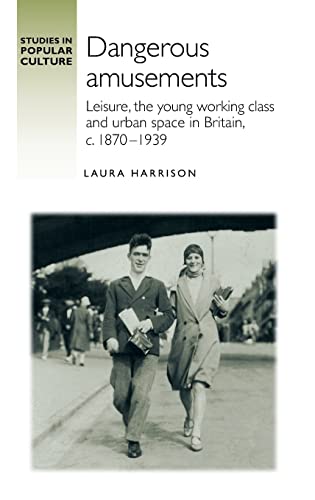
Dangerous Amusements: Leisure, the young working class in urban space in Britain, 1870-1939
My first book traces the beginnings of a distinct youth culture in streets and neighbourhoods across Britain, and was published by Manchester University Press in June 2022. In neighbourhoods and public spaces across Britain, young working people walked out together, congregated in the streets, and paraded up and down on the ‘monkey parades’.
Drawing on an extensive range of sources, from newspapers and institutional records to oral histories and autobiography, this book explores the relationship between the leisure lives of the young working class and urban space, offering new perspectives on a number of familiar and important themes in British social history, such as leisure and consumption, street cultures, courtship and sexuality.
Doing working-class history: Research, heritage and engagement
Doing Working Class History iscurrently in production with Routledge. Economic and political uncertainty has brought the language of class — especially discussion of the working class — to a broad audience across scholarship and social debate. This introductory volume shows how the history of the working class has, is, and can be researched, written, and represented.
With chapters covering a span of the years c.1750 – present, the book focuses on three essential questions:
1. What is working-class history and what should it become?
2. What can a focus on working-class history reveal?
3. What are the possibilities of this research in the University classroom, the heritage world, and beyond?
Journal articles
My published work has primarily focused on histories of youth and youth culture in Britain, exploring the intersections of age, gender, class and race. I have also published on urban poverty and the attempts made by reformers to understand and ‘map’ the slums of the Victorian and Edwardian city, and institutional attempts to informally police young women’s behaviour in public. A recent article for Rural History looks at memories of growing up in the countryside in the early twentieth century, as recalled in memoirs and oral history interviews.
I also have an interest in creative practice and its application in the History HE classroom, and have published on collaborative teaching with colleagues in sustainable business and IT.
If you would like to read any of my academic articles and don’t have access, please get in touch.
Laura Harrison, Rose Wallis, Alexis Evans and Libby Everall, ‘Sex and the social order: creative approaches to teaching the history of gender and sexuality in modern Britain’, History: The Journal of the Historical Association (forthcoming, 2024).
As History researchers and teachers, we want our students to discover the excitement that can be found in original historical research, and in how this research can be used to make a difference in and with our communities, with authentic learning experiences that recognise historical thinking does not only take place in academic essays and monographs. Teaching, research, and public engagement are intertwined in this approach, creating a classroom environment that opens up intellectual and emotional room for creativity and curiosity, letting students come to important questions and conclusions on their own. This article focuses on one example of this method of teaching; a module for second-year History students at the University of the West of England, Bristol (UWE): ‘Sex and The Social Order: Gender and Sexuality in Modern Britain’, designed and led by Laura Harrison, co-taught with Rose Wallis. Alexis and Libby reflect on their experiences as students on the module.
Ian Brooks, Laura Harrison, Mark Reeves, Martin Simpson and Rose Wallis, ‘History-enhanced ICT For Sustainability Education: Learning together with Business Computing students’, ICT4S, 2024.
Laura Harrison, ‘There wasn’t all that much to do … at least not here’: Memories of growing up in rural South West England in the early twentieth century, Rural History, 31:2 (2020), pp. 165 – 180 (open access).
Stan was born in 1911 in a small village near the north Somerset coast. When recalling his life in the countryside, he felt that ‘there wasn’t much to do in the evenings … at least not here’. Drawing upon evidence from personal accounts of growing up in the south west of England in the early twentieth century, this article examines memories of youth in the countryside, with a particular focus on the leisure lives of young people and their experiences of rural space and place. In addition to adding to our knowledge on the lives of rural youth, this study also provides new insights into the complex relationship between people and their environment, and has implications for our understandings of the early formation of a distinct youthful identity in England. The countryside was not simply a backdrop in these recollections; rather, it was formative in how those that grew up in rural communities understood their experience of being young.
Laura Harrison, ‘The streets have been watched regularly’: The York Penitentiary Society, young working-class women, and the regulation of behaviour in the public spaces of York, c. 1845– 1919, Women’s History Review, 28: 3 (2019), pp. 457-478.
Laura Harrison, Creating the slum: Representations of poverty in the Hungate and Walmgate districts of York, 1875-1914, Ex Historia, 7 (2015), pp. 61-89 (open access).
Book chapters
Laura Harrison, ‘The unessay: creative approaches to assessment when teaching the history of gender and sexuality in modern Britain’, History UK (forthcoming, 2025).
Laura Harrison, Everyone has a tale to tell: Family history, family historians and working-class histories, Doing Working-Class History, Routledge (forthcoming, 2024).
In this chapter, I consider the multiple decade-long boom of family history and how it connects to the research and practice of working-class history. Family history, the chapter argues, has much to offer the historian both in terms of source material but also as a bond between subject, practitioners, and audience. I also reflect on what a personal journey family history can be for the historian, particularly those with working-class ancestors – an inspiring but emotional process.
Laura Harrison, Street Life: The leisure spaces and places of working-class youth in Britain, c.1870-1960, Doing Working-Class History, Routledge (forthcoming, 2024).
Other writing
Laura Harrison, ‘History and Sustainability: learning together with ICT students’, published on the Royal Historical Society blog.
Laura Harrison, ‘We didn’t think it was monotonous in those days, but…’ : Memories of growing up in rural South West England in the early twentieth century, Regional Historian, (2020), 69-74.
Since 1997, The Regional History Centre at UWE has published new histories of South West England. Starting as a newsletter, and now as an annual yearbook, the Regional Historian presents new research from academics, students and public scholars about Bristol and the region, for a public audience.
I have written book reviews for journals including Social History and Women’s History Review.
 Dr Laura Harrison